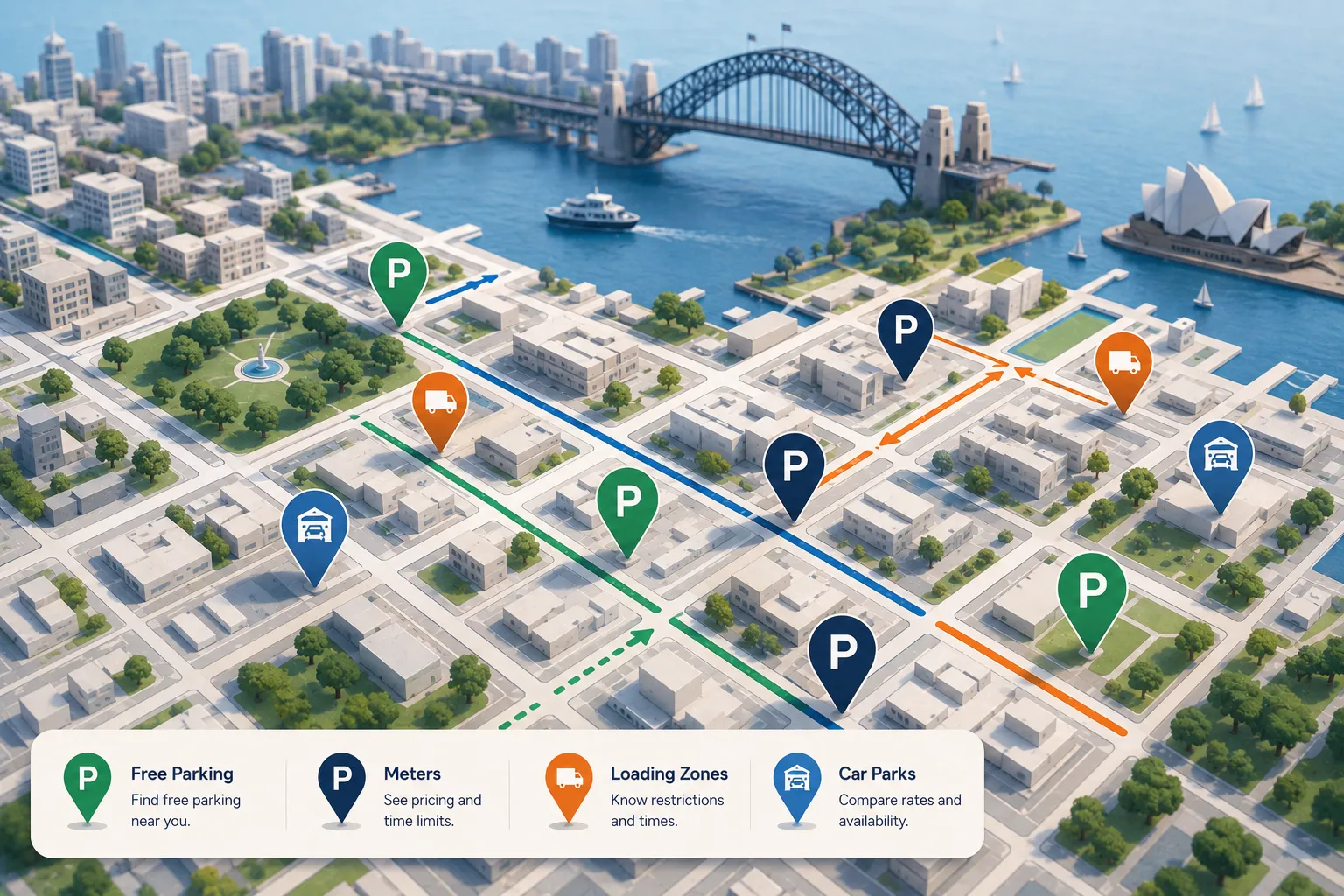
Most people are not trying to study urban behaviour.
They are just trying to park their car.
That sounds simple until you reach Bondi, Surry Hills, Newtown, Manly or the Sydney CBD and the first available space comes with four signs, two arrows, a meter number, a permit exception and a car behind you waiting for you to make a decision.
In that moment, parking stops being a storage problem.
It becomes a behavioural system.
The driver is not only asking, “is there a space?”
They are asking: can I stop here, can I understand the sign quickly enough, do I need to pay, will I get fined, how far will I have to walk, and should I even come back to this area next time?
That is the part of parking that interests me more and more as I build Park Me For Free.
Sydney parking is not just difficult because spaces are limited. It is difficult because the rules are uncertain, scattered and often hard to interpret at the exact moment a driver needs to act.
Parking uncertainty changes urban behaviour before the car even reaches the kerb.
The second lap around the block
Every Sydney driver knows the second lap.
The first lap is optimistic. You are still looking for the obvious space. You are scanning the street, checking driveways, watching pedestrians and trying to read signs without annoying the person behind you.
The second lap feels different.
By then, the driver has started negotiating with themselves.
Maybe I can park further away.
Maybe that loading zone is inactive now.
Maybe the permit sign only applies after 6pm.
Maybe I should just pay for the car park.
Maybe I should not have come here at all.
That second lap is not just wasted time. It is evidence.
It shows that the driver expected one thing and found another. It shows that the parking environment did not give them a clear enough answer. It shows that local traffic can be shaped by hesitation, ambiguity and small repeated decisions.
A city does not need every driver to circle for parking to create a problem. It only needs enough uncertainty in the wrong places at the wrong times.
Parking is not just a supply problem
The easy version of the parking debate is about supply.
Do we have enough spaces? Should there be more? Should there be fewer? Should the price go up? Should the council add permits? Should visitors be pushed into off-street car parks?
Those questions matter, but they are not the whole system.
A driver’s parking decision is a stack:
Can I find a space?
Can I legally stop there?
Can I understand the sign?
Can I pay or satisfy the permit rule?
Will I get fined?
How far will I need to walk?
Will I come back next time?
Most parking products focus on the first question.
The real behaviour happens across the whole stack.
A space that looks available but is legally confusing does not feel available. A cheap space with unclear restrictions does not feel cheap. A street with parking that only locals understand is not equally useful to everyone.
Parking knowledge is unevenly distributed.
Locals park by memory. Visitors park by anxiety.
The uncertainty tax
I think of this as the uncertainty tax.
The uncertainty tax is the extra time, attention, stress, fuel and risk drivers pay when the city cannot make kerbside rules easy to understand.
It shows up in small ways.
A driver slows down too early because they are trying to read a sign. Someone stops awkwardly with their indicator on because they are not sure whether the space is legal. A driver takes the first plausible space even though it is further away because they do not want to keep searching. Someone pays for an off-street car park because the street rules feel too risky.
None of those moments look dramatic by themselves.
But across a busy suburb, they add up.
The hidden cost is not just time. It is attention.
A parking sign is not just a rule. It is legal UX presented to a person who is already driving.
That is a brutal interface.
What the research gets right, and what it does not prove
There is a famous parking idea that a large share of city traffic can come from people cruising for parking.
That can be true in some congested downtown contexts, but it is dangerous to lazily copy those numbers into Sydney and pretend they apply everywhere.
The better conclusion is more careful.
Parking search is real. It can create extra driving, frustration, emissions and congestion. But the size of the effect depends heavily on the location, time of day, price, off-street alternatives, local rules and how the measurement is done.
That matters for Sydney.
The CBD is not Bondi. Bondi is not Manly. Manly is not Chatswood. A weekday loading zone on York Street is a different behavioural problem from a sunny Sunday near the beach.
The mistake is treating parking as one generic issue.
It is local, timed and highly dependent on context.
That is why parking data needs to be interpreted, not just displayed.
Beach parking is where transport becomes politics
Beach suburbs make the behavioural side of parking obvious.
In places like Bondi, Bronte, Tamarama and Manly, parking is not just about where cars go. It is about residents, visitors, businesses, tourism, fairness, public space and local identity.
Residents want access to their own streets. Visitors believe the beach is public. Businesses want turnover. Councils need to manage demand without turning every local street into a fight.
Resident permits are often treated like a solution, but they are not magic.
A resident permit does not create a parking space. It creates a priority claim on a scarce one.
If more permits exist than practical spaces, the resident still has to compete. If one area becomes more restricted, the pressure can move to the next street. If visitors feel locked out, they either pay more, walk further, avoid the area or arrive earlier.
That is why parking schemes are behavioural systems.
Change one rule and people adapt around it.
Digital permits do not remove scarcity
Manly moving toward digital permits is a good example of the next phase of parking management.
Digital permits can make administration cleaner. They can link permission to vehicle registrations. They can reduce reliance on physical stickers and make enforcement easier.
That is useful.
But it does not remove the underlying constraint.
A digital permit can clarify who is allowed to compete for parking. It cannot guarantee that a space exists.
This is where parking technology needs to be honest.
Better systems can reduce confusion, improve enforcement and make rules easier to manage. They cannot pretend scarcity has disappeared just because the database is cleaner.
The same is true for a parking app.
Park Me For Free should not promise miracle spaces. It should help people make better decisions with the best available evidence.
Central Sydney is a different kind of pressure
The Sydney CBD has another version of the same problem.
The issue is not just finding a space. It is understanding what kind of kerb space you are looking at.
A single street can involve loading zones, paid parking, no-stopping windows, taxi and point-to-point pickup areas, permit exceptions, bus zones and event restrictions. The same physical kerb can mean different things at different times of day.
That creates a high-stakes interpretation problem.
A driver might see that a paid meter is inactive and assume the space is free. But an inactive paid rule does not automatically mean parking is allowed. Another restriction might be active. The space might be for loading. The dataset might be silent. The sign might have changed.
That was one of the biggest lessons from building the app.
Missing paid evidence is not the same as free parking.
The system needs to ask a harder question:
What positive evidence says this driver can park here now?Not:
What paid rule failed to appear?Free parking has to be earned.
The first-available-space bias
Uncertainty also changes how people choose between options.
In a perfectly informed world, a driver might compare price, walking distance, time limit, fine risk and availability.
In the real world, they often take the first space that feels good enough.
That space might be further from the destination. It might be more expensive. It might have a worse time limit. But it reduces anxiety, so the driver takes it.
This is the first-available-space bias.
It is not irrational. It is a response to uncertainty.
When the driver does not know whether the next street will be better or worse, stopping early can feel safer than searching intelligently.
That is another reason better information matters.
A good parking product does not just show spaces. It reduces panic decisions.
Parking signs are legal UX
NSW parking signs are not impossible to understand, but they can be expensive to parse in motion.
A driver may need to process:
Restriction type
Time window
Day window
Direction arrow
Permit exception
Vehicle class
Paid meter requirement
School-day condition
Clearway or no-stopping rule
Nearby default road rules
The problem is rarely one sign.
The problem is the whole environment.
A driver is trying to read a legal instruction while moving through traffic, watching mirrors, avoiding cyclists, noticing pedestrians, checking the car behind them and deciding whether to pull in.
That is a lot to ask.
The city might technically provide the rule. That does not mean the rule is usable at the moment of decision.
Public information only creates value when people can actually use it.
The product should reduce uncertainty, not fake certainty
This is why I keep coming back to confidence.
A parking app should not just say:
Park hereIt should be able to say:
Allowed now
Paid meter required
Allowed until 6pm
Loading zone active
Permit holders excepted
Unknown because evidence conflicts
And it should explain why.
A useful parking decision might look like this:
2P paid parking active now
Confidence: High
Evidence:
- council meter data
- mapped parking restriction
- no conflicting loading-zone rule found
Or:
Parking status unknown
Confidence: Low
Reason:
- paid meter data is inactive
- no positive evidence confirms parking is allowed
- nearby restriction data is incomplete
That second answer is less exciting, but it is more trustworthy.
A bad app turns missing data into green markers.
A better app admits uncertainty before it gives someone a false sense of safety.
The second lap is data
One product idea I keep thinking about is measuring parking uncertainty directly.
The second lap around the block is not just a user frustration. It is a signal.
Repeated low-speed loops near a destination could suggest parking search. A driver switching from street parking to off-street parking could suggest uncertainty. Time spent near the destination before the trip ends could suggest difficulty. Opening sign details or restriction explanations could show where the rules are not obvious enough.
None of these signals are perfect by themselves.
But together, they can help answer a better question:
Where does parking uncertainty actually change behaviour?That is much more useful than only asking where parking exists.
Because the real problem is not always lack of spaces. Sometimes it is lack of confidence.
Better information changes behaviour
A better Sydney parking map will not fix every transport problem.
It will not create infinite kerb space. It will not remove beach demand on a hot Sunday. It will not make the CBD simple. It will not stop councils from needing permits, loading zones, clearways and enforcement.
But better information can still change behaviour.
It can help a driver choose an off-street car park before they start circling. It can help someone avoid a loading zone. It can help a visitor understand a permit-heavy suburb before they arrive. It can help locals compare options instead of relying only on memory. It can help councils make public data actually useful to the public.
That is the point of Park Me For Free.
Not just to find parking.
To reduce the uncertainty tax.
What I am building toward
The long-term goal is a Sydney parking system that understands parking as a decision, not just a location.
That means combining council data, transport data, street rules, meter information, off-street car parks, permit areas, live feeds where they exist, confidence levels and explanations that normal people can understand.
The app should be conservative when the evidence is weak.
It should not call a space free just because a paid meter is inactive. It should not ignore loading zones because they are inconvenient. It should not treat a resident permit as a guaranteed space. It should not pretend digital systems remove scarcity.
The most valuable parking product is not the one that promises a miracle space.
It is the one that helps a driver make a calm, correct decision before the second lap begins.